
Russia on Tuesday fumed over the arrest of 10 suspected spies in the United States by the Federal Bureau of Investigation, an incident reminiscent of the Cold War hostilities, warning it would be a blow to the Obama-Medvedev 'burger' diplomacy and the 'reset' in the bilateral ties.

US President Barack Obama is in China on a three-day official visit that will be aimed at resetting bilateral ties and hoping to win China's support on issues ranging from climate change to sanctions against Iran. Obama, who is on his first to China after becoming president in January this year, is hoping to navigate an increasingly complex relationship with a country that is the largest holder of US foreign debt and its second-largest trading partner.

United States President Barack Obama and his Russian counterpart Dmitry Medvedev on Monday signed a landmark deal in Moscow committing the two Cold War rivals to a new, legally binding arms-control treaty and resume military cooperation, as they promised to "reset" their damaged bilateral ties.

We have seen great strides in all-around cooperation, Chinese foreign ministry spokesperson said.

Naravane is scheduled to meet Prime Minister K P Sharma Oli on Friday.
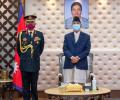
PM Oli said that "there has been good friendship between Nepal and India".

Nepal witnessed political turbulence in 2022 that dramatically turned rivals into allies and throned former guerrilla leader Pushpa Kamal Dahal 'Prachanda' as the prime minister for a third time, as Kathmandu made efforts to balance ties with immediate neighbours India and China with high-profile talks and visits.

The PM said his visit -- the first ever by an Indian premier -- was "based on the deep centuries-old connection between our two peoples."

Shringla began his two-day official visit to Nepal on Thursday. He was accorded a warm welcome on his maiden visit to Nepal which is happening at the invitation of Nepal Foreign Secretary Paudyal, amid a strain in bilateral ties following a bitter border row between the two countries.

Gen Naravane on Tuesday said he was eagerly looking forward to the visit and exuded confidence that it will go a long way in strengthening the "bonds of friendship" between the armies of the two countries.

Pakistan Prime Minister Imran Khan on Thursday began his engagements in Moscow by laying a wreath at the Tomb of the Unknown Soldier, and is scheduled to meet Vladimir Putin, hours after the Russian president ordered a special military operation in eastern Ukraine, ignoring last-minute appeals and warnings from the West.

Shigeru Ishiba is expected to prioritise strengthening Japan's military capabilities and fostering deeper international partnerships, particularly with India, with whom Japan shares significant strategic interests, explains Dr Rajaram Panda.

Rejecting Biden's comments, Pakistan foreign minister Bilawal at a press conference here said that Pakistan was following the global standards.

'The world is watching carefully. The choices India makes today have consequences beyond its borders.'
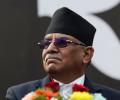
Former Nepalese foreign minister Ramesh Nath Pandey observed that the current situation is not encouraging for India-Nepal ties, saying the "present leaders" created irritants in the relationship in the past.

Gen Naravane's visit to Nepal from November 4-6 is largely aimed at resetting bilateral ties that came under severe strain following a bitter border row between the two countries.
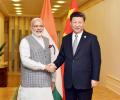
'At the informal summit, the two leaders will have heart-to-heart discussions on overarching issues and try to build mutual trust'

Doval's visit was 'part of regular high-level engagements between India and China', an Indian Embassy press release in Beijing said.

Imran said the previous Pakistani governments "should not have pledged what they could not deliver."

'India stands to gain immensely by forging a developmental partnership with China.' 'While through sustained strategic communication there is scope to steadily expand the commonality of interests between the two countries.' 'This is also a practical way to ensure that differences do not get over-magnified and become disputes,' says Ambassador M K Bhadrakumar.

An MoU on sharing hydrological information of the Brahmaputra River by China to India and another pact on amendment of the protocol on phytosanitary requirements for exporting rice from India to China to include non-Basmati rice were signed after the Modi-Xi talks in the eastern Chinese port city.
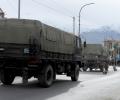
China is in no hurry to disengage at the border and the region and international community is moving on. The spectre of a long haul in Ladakh haunts India, points out Ambassador M K Bhadrakumar.
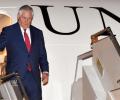
Pakistan Prime Minister Shahid Khaqan Abbasi assured the Secretary of State that his country is committed to the war against terrorism.

The exercise 'Hand-in-Hand' between the armies of the two countries will take place within next 4-5 months in China.

Pakistan is once again becoming a frontline State in big-power rivalry. But this time around, Pakistan stands to gain out of its geography, observes Ambassador M K Bhadrakumar.

'I couldn't think of a more visible strategic form of cooperation than both of our armed serves using a similar weaponry jointly developed together.' Aziz Haniffa/Rediff.com reports from Washington, DC on what is expected in the India-US defence relationship during Prime Minister Modi's visit.

'Previous governments in India had reservations about working with Israel.' 'Modi has shed this tag.' 'Disengaging itself from its traditional and ideological foreign policy approach in the Middle East shall serve India's long-term interests.' Rajaram Panda explains why the significance of Modi's visit to the Jewish nation goes beyond markers like the first-ever visit to Israel by an Indian PM and 25 years of diplomatic ties.

The US election campaign has provided plenty of ammunition for the CCP to make its case that its political system is superior.

India and Sri Lanka on Friday signed four agreements during Narendra Modi's maiden visit to the country, the first bilateral tour by an Indian premier in 28 years, with the prime minister announcing a slew of measures aimed at resetting ties with the strategic neighbour.

Pak seeks US help to ease tensions with India.
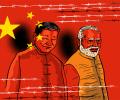
'As China rises and India grows to reclaim their earlier positions on the world stage as two of the largest economies and most important countries, there will indeed be some contention between these two powers.' 'There will also be plenty of space and room for cooperation amongst the two of us.' 'As our economic size increases to match the fact that we are the two most populous nations on earth, it will be all the more important for us to keep the interests of our peoples as well as those of the rest of the world in mind.' 'We shall have to grow together rather than as separate and disparate entities,' points out Ambassador Gautam Bambawale -- who served as India's ambassador to China -- in the 7th annual lecture of the Indian Association of Foreign Affairs Correspondents on March 1, 2019.

Chinese President Xi Jinping's visit to India is a time for the two countries to get away from the haze of rhetoric and stale euphoria, says Sana Hashmi.
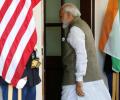
We see none of the euphoric build-up customary to India's encounter with US presidents in recent times. This gives Modi wriggle room to work on the much-needed reset of India-US ties.

'New Delhi showed itself willing -- at least for a period -- to tolerate the risk of conflict and to withstand Beijing's implicit and explicit threats.' 'But it also continued to try to cut some kind of deal with China to reduce tensions.'
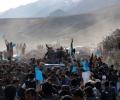
If Afghanistan is going to make any gains through democratic reforms, the newly elected president must start with addressing corruption at all levels of government and developing a comprehensive government financing plan independent of American support.

Abstaining from voting on a UNHRC resolution on Sri Lanka was dictated as much by necessity and self-preservation as by a desire to place bilateralism at the front and centre of New Delhi's ties with Colombo, says Ramesh Ramachandran.

The India-Afghanistan relationship does not have to be a template of each country's relations with Pakistan, and Delhi will do well to leave it to Ghani to redefine the parameters of Afghanistan's security cooperation with India. A zero-sum mindset can only exacerbate regional tensions, says Ambassador M K Bhadrakumar.
